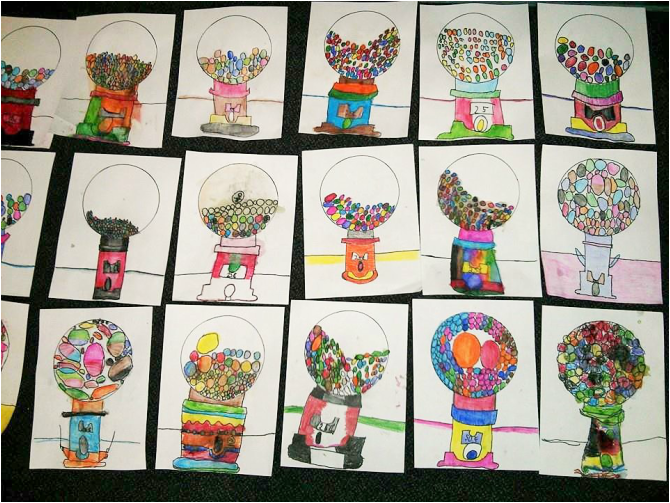
third grade
Youtube Video Links -
History - youtu.be/9YP7aPsNQ4Q Demo -
History - youtu.be/9YP7aPsNQ4Q Demo -
Wayne Thiebaud, gumball machine
Although we look at other Pop Artists in this curriculum (including Andy Warhol, Roy Lichtenstein, Jim Dine and Jasper Johns), American artist Wayne Thiebaud (born November 15, 1920) may stand out to a classroom of young elementary students because of his focus on food! Pies, ice cream cones, pastries, hot dogs, and even gumballs are common enough to fit with the idea of Pop Art's use of everyday objects, but fun enough to entice us with their graphic interest.
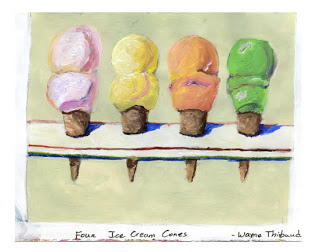
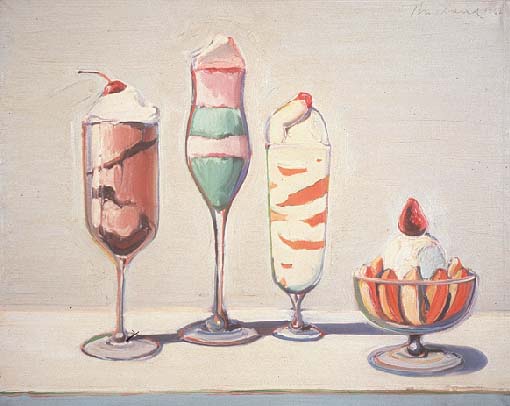
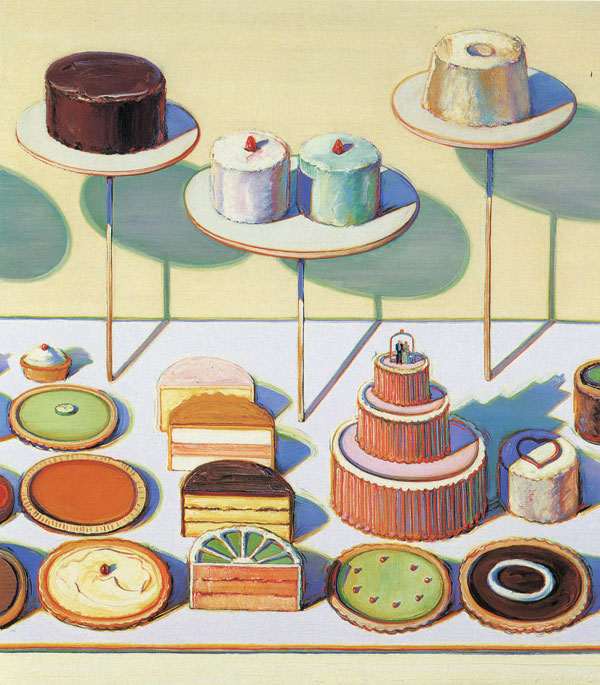
Thiebaud started out his art career by making a series of small paintings based on images of food displayed in store windows, as well as in diners and cafeterias. He was not just interested in the food, but also in the basic shapes of the food, and you may notice his careful arrangement of objects according to their shape. He also uses heavy pigment to create his paintings along with exaggerated colors. Most of his paintings also exhibit well-defined shadows, which give his pictures the crisp look of a magazine advertisement.
Thiebaud loved realism and most of his paintings are created using traditional artistic methods. He also advocated an emphasis on hard work as a supplement to creativity.
Thiebaud loved realism and most of his paintings are created using traditional artistic methods. He also advocated an emphasis on hard work as a supplement to creativity.
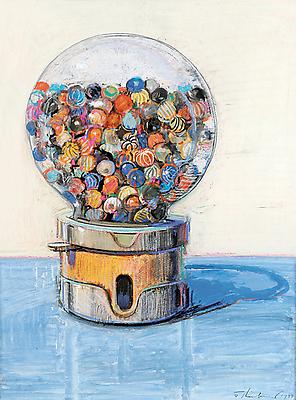
Wayne Thiebaud, "Gumball Machine," 1977.
the project
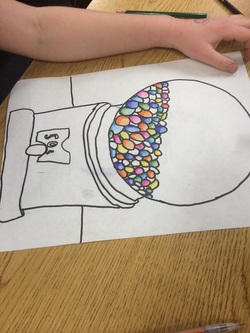
Prep
–
45 min. (includes time for sample, leave part of sample not done with
watercolor pencils so you can do it as part of the lesson in class)
Print –
Materials
*trace coffee can circle on each piece of paper before you teach project
9 x 12 white construction paper for each student
Coffee can in clay cabinet, trace coffee can circle at top of white paper for each student
2 boxes of water color pencils
Water containers
Paint brushes for each student
Black Sharpies (check out in office)
Lesson
Print –
Materials
*trace coffee can circle on each piece of paper before you teach project
9 x 12 white construction paper for each student
Coffee can in clay cabinet, trace coffee can circle at top of white paper for each student
2 boxes of water color pencils
Water containers
Paint brushes for each student
Black Sharpies (check out in office)
Lesson
- Show
students print. Ask students: who loves
sweet treats and desserts? Tell them the
artist we are going to learn about today paint all the desserts and
treats. Go over history of artist and
talk about what they see in the print. Especially point out the way he repeats shapes.
- Show
them your sample gumball machine and tell them they will be creating their own
gumball machine today.
- Show
them the white construction paper with the circle traced on it and explain to
them that they will draw the bottom part of the gumball machine on their
own. Draw a big circle on the white
board and then draw the bottom part of the gumball machine so the students have
something to look at while they draw.
- Tell
them that they can draw 25 cents on gumball coin slot, but we won’t be putting
any other words on our gumball machine.
- Color
in part of your gumball machine sample and use the paint brush and water to
show students how the water color pencils work. You only need to color in half
of the gumball and one side of the machine.
You will then use the paint brush and water to move the color across the
gumball or the machine to fill the color in.
- Students
can choose how many gumballs they draw in their gumball machine. Some students will draw a full gumball
machine and others will draw it less than half full.
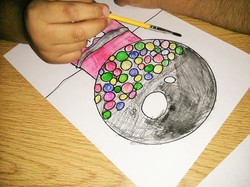
Art Project
-pass out white paper to each student
-have students put their name on the back
-lead students in drawing bottom half of gumball machine
-let students fill in their gumball machines with gumballs
-have students draw a line on either side of the gumball machine to edge of paper to show that the gumball machine is sitting on something
-when students are finished with their pencil drawing, have a parent volunteer walk around and pass out black Sharpies to trace over all pencil lines
-when students are done tracing with black Sharpies, have them raise their hand and a parent volunteer can collect Sharpies and give students water color pencils
-remind students they need to do all coloring with water color pencils before they start with paint brush and water
-when students are done coloring ask them to raise their hands to pass out water containers that are half full and a paint brush
-when students are finished with their project, collect supplies and wash out paint brushes to dry in art room
-let art projects dry on desk or on carpet in back of class. Have parent volunteers move art work.
-pass out white paper to each student
-have students put their name on the back
-lead students in drawing bottom half of gumball machine
-let students fill in their gumball machines with gumballs
-have students draw a line on either side of the gumball machine to edge of paper to show that the gumball machine is sitting on something
-when students are finished with their pencil drawing, have a parent volunteer walk around and pass out black Sharpies to trace over all pencil lines
-when students are done tracing with black Sharpies, have them raise their hand and a parent volunteer can collect Sharpies and give students water color pencils
-remind students they need to do all coloring with water color pencils before they start with paint brush and water
-when students are done coloring ask them to raise their hands to pass out water containers that are half full and a paint brush
-when students are finished with their project, collect supplies and wash out paint brushes to dry in art room
-let art projects dry on desk or on carpet in back of class. Have parent volunteers move art work.